THE VISUAL WINE FIELD GUIDE
Know the region.
Understand
the wine.
Connect the place on the label to the wine in your glass.
Visual wine maps and focused workbooks that connect place, grapes and winemaking to wine style. For curious drinkers, serious students and the people who sell and serve wine.
A little more understanding. A lot more enjoyment.
Bordeaux
Two banks. A world of difference.
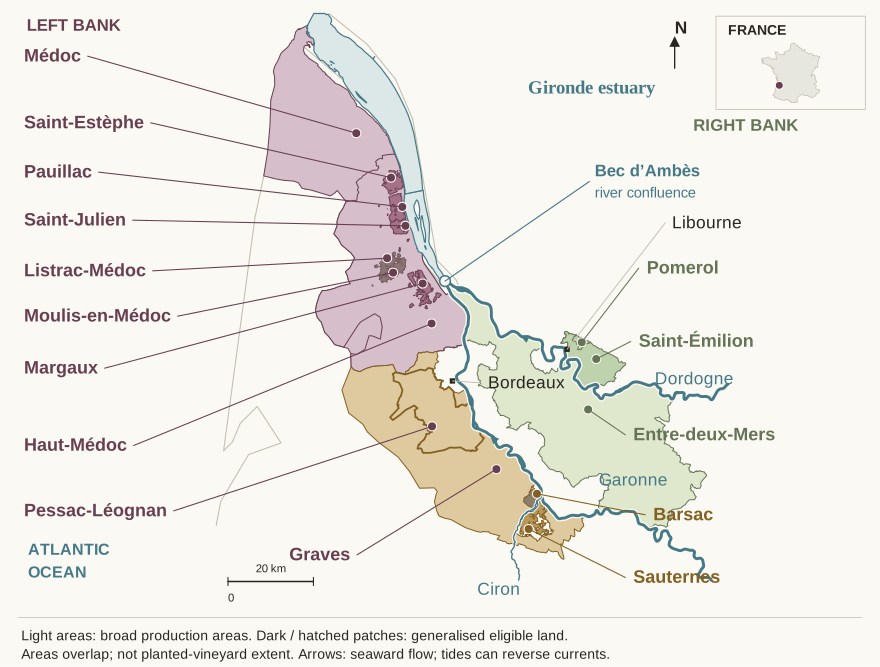
An original study map. Made to make connections.
LESS MEMORISING. MORE CONNECTING.
Wine makes more sense
when you see the whole picture.
A name is a start. Understanding why the wine tastes the way it does is where it gets interesting.
Know Your Cru brings the big ideas into focus, then gives you a reason to use them. Look, make a connection, explain it in your own words — and come back to the details that matter.
- 01 / SEE IT
Find the connection.
See the rivers, regions and neighbouring appellations together.
- 02 / UNDERSTAND IT
Follow the why.
Connect climate, site and grapes to the possibilities in the glass.
- 03 / MAKE IT YOURS
Put it into words.
Try a question. Explain a contrast. Check what you missed.
THREE REGIONS. COUNTLESS CONNECTIONS.
Pick a place.
Find your bearings.
Start with the big picture.
Stay for the details that change your understanding.
Original cartography · Generalised educational mapATLANTIC INFLUENCE · THE ART OF THE BLEND
Bordeaux
Two banks.
Different starting points.
Cabernet Sauvignon often leads on the Left Bank; Merlot is more prominent on the Right. Explore how site, grape choice and blending help explain the contrast.
- Look for
- Gravel, clay and limestone — with variation within each bank.
- Think about
- Why the blend matters more than a single grape name.
Regional patterns are starting points. Site, vintage, producer and winemaking shape each bottle. Map and product previews remain under factual and print review.
Read the regional guides
Explore the ideas behind the maps, with explanations and links to the regional wine bodies.
A TWO-MINUTE TASTE
Less “where is it?”
More “why does
it matter?”
Try three connections from Bordeaux and the Rhône. Take your time — the explanation is the useful part.
Why might a producer blend Merlot and Cabernet Sauvignon?
Choose one to see the connection.
Keep going in the full app, with short lessons and practice for Bordeaux and the Rhône.
Open the appA learning sample, with nothing to sign up for. Your answers stay in this page.
THE COLLECTION IN DEVELOPMENT
A clearer view.
On paper, too.
Regional study maps and supporting practice.
Designed to be used, annotated and returned to.
A place for
the bigger picture.
Current review editions bring a map, key grapes and concise soil and wine-style cues onto one spread.
CURIOUS BY NATURE. SERIOUS ABOUT WINE.
For the “tell me more”
kind of wine person.
You might be studying with purpose, finding the words for a customer, or following a question from your last glass. There’s room for all of it here.
Know Your Cru is an independent wine-learning project. The aim is simple: make the important connections easier to see, and give you more to enjoy in every region you explore.
A FEW GOOD QUESTIONS
Before you
dive in.
Who is Know Your Cru for?
Curious wine drinkers, students who already know the basics, and people who sell or serve wine. The material connects regional knowledge to wine style, with enough detail to invite a closer look.
Is this an accredited course?
No. Know Your Cru is an independent learning resource. It is not affiliated with, endorsed by, or a substitute for any awarding body or accredited course.
Can I buy the maps or workbooks?
This website introduces the developing collection. The materials are still under factual and print review, and this website has no shop or checkout. The on-page sample is available to explore now.
Are the maps exact vineyard boundaries?
No. They are generalised educational maps. Appellation production areas can overlap and do not represent planted-vineyard extent. See the source notes for the map data and limitations.